
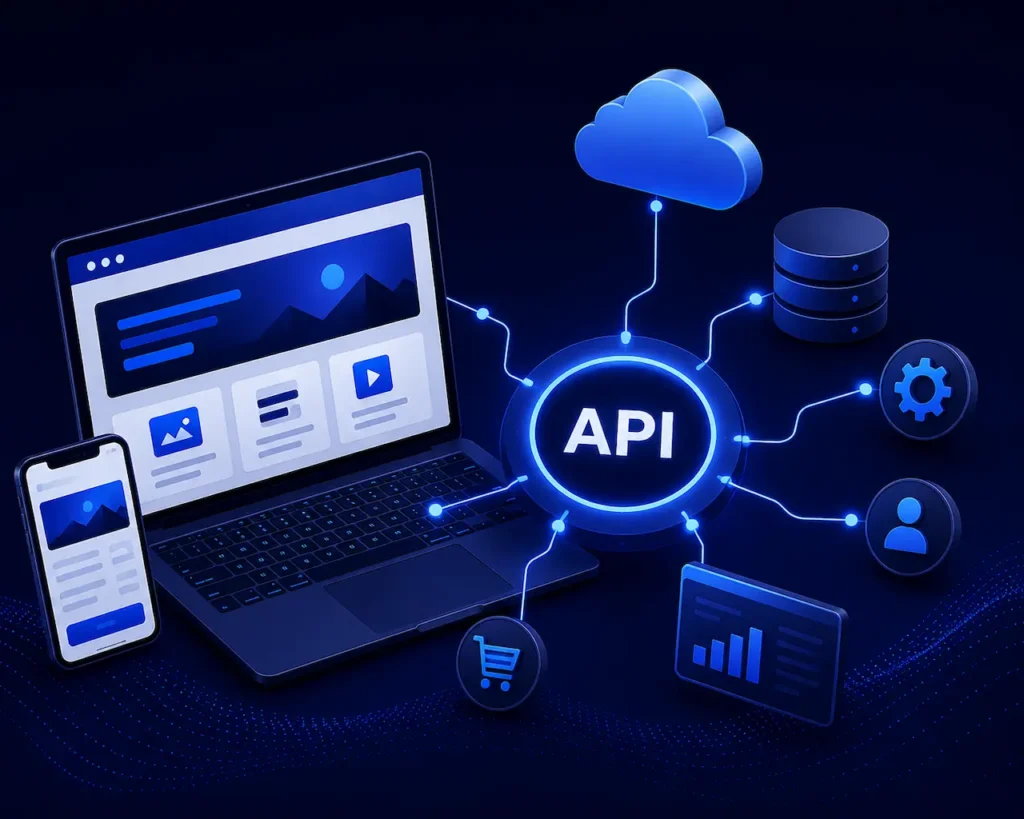
API Integration Guide for Business Websites and Web Apps is ultimately about one business decision: how to exchange data and trigger workflows reliably without creating hidden operational or security risk. The difficult part is rarely a single screen, plugin, or configuration option. It is coordinating content, technology, people, data, approvals, measurement, and ongoing ownership so the complete experience works after launch.
This guide is written for business and technical teams connecting websites or web applications to external systems. It provides a practical framework for discovery, implementation, quality assurance, and operation. It does not promise a universal result or substitute generic benchmarks for evidence from your own users, systems, analytics, and business records.
The main risk is treating a successful test request as a finished integration while ignoring contracts, failures, duplicates, rate limits, permissions, monitoring, and change management. A stronger process makes assumptions visible, assigns owners, tests representative scenarios, and records what was verified. Use the sections below as a working brief, review checklist, and set of questions for internal teams or external partners.
What API integration guide should accomplish
An API integration connects two independently changing systems. Reliability depends on clear ownership, stable identifiers, validated data contracts, secure authentication, failure handling, observability, support, and a plan for provider changes.
Before choosing tools or approving a design, connect the work to a measurable operating outcome. Define who benefits, which task becomes easier or safer, what existing behavior must be preserved, and how the organization will know the change is acceptable. Where data is incomplete, label the assumption and decide how it will be tested.
Scope should include the full path from a visitor or user action to the internal result. That may include content, forms, accounts, payments, notifications, CRM or ERP records, analytics, support, and recovery. A page can look correct while the broader workflow fails, so acceptance must extend beyond the visible interface.
Define the business workflow and source of truth
Start with the event, data, decision, and operational outcome. For every field, name the authoritative system and whether synchronization is one-way, two-way, real-time, or scheduled.
For this part of the project, document the current state, the desired state, the owner, inputs, outputs, dependencies, constraints, and acceptance evidence. Review the needs of business and technical teams connecting websites or web applications to external systems rather than relying on the preferences of the implementation team. If a choice affects security, privacy, accessibility, search visibility, money, or business continuity, record the decision and approver.
Questions and checks
- Map the end-to-end workflow
- Name each field owner
- Define timing expectations
- Document manual fallback
Test this area with realistic content and representative conditions. Include a successful path, invalid or incomplete input, unavailable dependencies, slow behavior, smaller screens, and any permission differences. Capture defects in a shared log with severity, steps to reproduce, evidence, owner, and retest status. That makes progress auditable and prevents unresolved issues from disappearing into chat or meeting notes.
Do not confuse completion with quality. A configured feature is not accepted until the relevant business owner can use it, the expected downstream result occurs, and the team knows how to support or reverse it. Keep optional improvements separate from launch blockers so urgent fixes do not trigger uncontrolled scope changes.
Design the data contract
Specify identifiers, required and optional fields, types, formats, enumerations, time zones, currencies, pagination, versioning, validation, and compatibility behavior.
For this part of the project, document the current state, the desired state, the owner, inputs, outputs, dependencies, constraints, and acceptance evidence. Review the needs of business and technical teams connecting websites or web applications to external systems rather than relying on the preferences of the implementation team. If a choice affects security, privacy, accessibility, search visibility, money, or business continuity, record the decision and approver.
Questions and checks
- Use stable external identifiers
- Reject or quarantine invalid payloads
- Preserve precision and time zone
- Version breaking changes
Test this area with realistic content and representative conditions. Include a successful path, invalid or incomplete input, unavailable dependencies, slow behavior, smaller screens, and any permission differences. Capture defects in a shared log with severity, steps to reproduce, evidence, owner, and retest status. That makes progress auditable and prevents unresolved issues from disappearing into chat or meeting notes.
Where several tools can satisfy the requirement, compare lifecycle cost and operational fit rather than selecting by feature count. Include licensing, implementation, content work, testing, training, monitoring, updates, specialist availability, data portability, and the consequence of replacing the tool later.
Secure authentication and authorization
Use the provider’s supported method, least-privilege scopes, encrypted transport, protected secret storage, rotation, expiry handling, separate environment credentials, and auditable access.
For this part of the project, document the current state, the desired state, the owner, inputs, outputs, dependencies, constraints, and acceptance evidence. Review the needs of business and technical teams connecting websites or web applications to external systems rather than relying on the preferences of the implementation team. If a choice affects security, privacy, accessibility, search visibility, money, or business continuity, record the decision and approver.
Questions and checks
- Never expose server secrets in browser code
- Limit token scope
- Rotate and revoke safely
- Protect logs and diagnostics
Test this area with realistic content and representative conditions. Include a successful path, invalid or incomplete input, unavailable dependencies, slow behavior, smaller screens, and any permission differences. Capture defects in a shared log with severity, steps to reproduce, evidence, owner, and retest status. That makes progress auditable and prevents unresolved issues from disappearing into chat or meeting notes.
Do not confuse completion with quality. A configured feature is not accepted until the relevant business owner can use it, the expected downstream result occurs, and the team knows how to support or reverse it. Keep optional improvements separate from launch blockers so urgent fixes do not trigger uncontrolled scope changes.
Handle webhooks, retries, and duplicates
Verify webhook signatures, acknowledge promptly, process asynchronously when appropriate, retry transient failures with backoff, and use idempotency to prevent repeated side effects.
For this part of the project, document the current state, the desired state, the owner, inputs, outputs, dependencies, constraints, and acceptance evidence. Review the needs of business and technical teams connecting websites or web applications to external systems rather than relying on the preferences of the implementation team. If a choice affects security, privacy, accessibility, search visibility, money, or business continuity, record the decision and approver.
Questions and checks
- Store event identifiers
- Make handlers repeat-safe
- Separate transient from permanent errors
- Use a dead-letter or review queue
Test this area with realistic content and representative conditions. Include a successful path, invalid or incomplete input, unavailable dependencies, slow behavior, smaller screens, and any permission differences. Capture defects in a shared log with severity, steps to reproduce, evidence, owner, and retest status. That makes progress auditable and prevents unresolved issues from disappearing into chat or meeting notes.
Where several tools can satisfy the requirement, compare lifecycle cost and operational fit rather than selecting by feature count. Include licensing, implementation, content work, testing, training, monitoring, updates, specialist availability, data portability, and the consequence of replacing the tool later.
Respect limits, latency, and dependency failure
Plan for quotas, burst limits, pagination, timeouts, provider maintenance, slow responses, partial outages, stale data, and circuit-breaking or graceful degradation.
For this part of the project, document the current state, the desired state, the owner, inputs, outputs, dependencies, constraints, and acceptance evidence. Review the needs of business and technical teams connecting websites or web applications to external systems rather than relying on the preferences of the implementation team. If a choice affects security, privacy, accessibility, search visibility, money, or business continuity, record the decision and approver.
Questions and checks
- Set explicit timeouts
- Cache only when safe
- Queue noninteractive work
- Display honest degraded states
Test this area with realistic content and representative conditions. Include a successful path, invalid or incomplete input, unavailable dependencies, slow behavior, smaller screens, and any permission differences. Capture defects in a shared log with severity, steps to reproduce, evidence, owner, and retest status. That makes progress auditable and prevents unresolved issues from disappearing into chat or meeting notes.
Do not confuse completion with quality. A configured feature is not accepted until the relevant business owner can use it, the expected downstream result occurs, and the team knows how to support or reverse it. Keep optional improvements separate from launch blockers so urgent fixes do not trigger uncontrolled scope changes.
Test, monitor, and operate the connection
Use sandbox and contract tests, fixtures, failure simulation, reconciliation, structured logs, metrics, alerts, dashboards, runbooks, ownership, and periodic access review.
For this part of the project, document the current state, the desired state, the owner, inputs, outputs, dependencies, constraints, and acceptance evidence. Review the needs of business and technical teams connecting websites or web applications to external systems rather than relying on the preferences of the implementation team. If a choice affects security, privacy, accessibility, search visibility, money, or business continuity, record the decision and approver.
Questions and checks
- Test malformed and missing data
- Reconcile source and destination counts
- Alert on sustained failure
- Document provider support paths
Test this area with realistic content and representative conditions. Include a successful path, invalid or incomplete input, unavailable dependencies, slow behavior, smaller screens, and any permission differences. Capture defects in a shared log with severity, steps to reproduce, evidence, owner, and retest status. That makes progress auditable and prevents unresolved issues from disappearing into chat or meeting notes.
Where several tools can satisfy the requirement, compare lifecycle cost and operational fit rather than selecting by feature count. Include licensing, implementation, content work, testing, training, monitoring, updates, specialist availability, data portability, and the consequence of replacing the tool later.
A practical implementation roadmap
1. Discovery and evidence
Interview the people who own the outcome and the people who operate the current process. Review analytics, search terms, support requests, forms, system records, policies, and representative user journeys. Turn findings into requirements with sources instead of converting every suggestion directly into scope.
2. Architecture and prioritization
Map content, components, data, permissions, integrations, environments, and ownership. Prioritize the smallest coherent release that can achieve exchange data and trigger workflows reliably without creating hidden operational or security risk. Record exclusions and future triggers so deferred work remains deliberate rather than forgotten.
3. Prototyping and technical validation
Prototype the highest-risk workflow before polishing every page. Validate assumptions about data, third-party services, performance, responsive behavior, accessibility, editing, and administration. A small proof can reveal an architectural constraint while it is still inexpensive to change.
4. Controlled implementation
Build with reusable patterns, versioned changes, separate environments, protected credentials, and documented decisions. Review work in small increments with real content. Keep production stable until acceptance evidence is complete.
5. Quality assurance and acceptance
Test content, interactions, permissions, browsers, responsive states, accessibility, performance, integrations, analytics, search controls, notifications, error handling, security basics, backup, and recovery as applicable. The final approver should understand open risks and the rollback plan.
6. Launch and stabilization
Release during an agreed window with named monitoring and support owners. Verify the production environment, annotate analytics, watch logs and business workflows, reconcile important records, and schedule a post-launch review. Keep a prioritized improvement backlog separate from incident response.
How to measure the outcome responsibly
Choose measures that reflect the actual goal and can be collected without exposing sensitive information. Combine behavioral signals with quality and operational measures. Depending on the project, that may include successful task completion, qualified enquiries, order accuracy, error rate, response time, support volume, accessibility defects, content findability, processing time, or the percentage of records that reconcile.
Document the baseline, measurement window, segmentation, data source, consent limitations, releases, campaigns, seasonality, and operational changes. A metric that moves after launch is not proof that one design choice caused the change. Use controlled experiments when feasible, and use careful before-and-after interpretation when they are not.
Common mistakes to avoid
- Starting implementation before goals, owners, dependencies, and acceptance criteria are written down.
- Optimizing the easiest visible page while ignoring complete user and operational journeys.
- Using production data, credentials, or side effects in testing without appropriate controls.
- Adding tools or plugins before identifying the actual bottleneck or requirement.
- Publishing performance, revenue, ranking, or conversion claims that cannot be verified.
- Launching without monitoring, a rollback path, named support ownership, and a post-release review.
A useful review separates defects, risks, hypotheses, and preferences. Defects fail an agreed requirement. Risks describe uncertain future harm. Hypotheses predict an outcome that needs evidence. Preferences may still matter for brand or stakeholder alignment, but they should not be presented as proven conversion or usability findings.
Questions to ask a web development partner
- How will you validate the requirements and define acceptance for API integration guide?
- Which work will your team perform, and which responsibilities remain with us?
- How will content, data, integrations, analytics, accessibility, security, and responsive testing be handled?
- What assumptions, exclusions, licenses, third-party costs, and change-control rules will appear in the proposal?
- Who owns accounts, source files, design assets, documentation, and operational access after launch?
- What is the backup, rollback, warranty, monitoring, training, and ongoing-support plan?
Compare answers with the delivery risk, not only the quoted build price. If you are still choosing between an agency, freelancer, or internal team, read Avenzo’s delivery-model comparison. For budget planning, review the factors behind business website cost in the USA.
Frequently asked questions
What is the difference between an API and a webhook?
An API is commonly called by one system to request or change data. A webhook is an event notification sent by a provider to a receiving endpoint. Many integrations use both.
Should integrations run in real time?
Only when the workflow needs it and dependencies can support it. Scheduled or queued synchronization may be safer for bulk data, rate limits, and recoverability.
How do you prevent duplicate records?
Use stable identifiers, matching rules, idempotency keys, unique constraints, event history, and reconciliation. Do not rely only on names or timestamps.
Turn the guide into an accountable project
The strongest API integration guide plan begins with explicit outcomes, evidence, ownership, and a complete view of the user and operational journey. Define what must be preserved, what may change, how risk will be tested, and who supports the result after release. That discipline usually creates more value than adding another unprioritized feature.
If the current foundation may still be viable, compare the options in website redesign versus rebuild. If you want help defining scope, architecture, content, integrations, quality assurance, and launch controls, start a project consultation with Avenzo Digital.
Related Avenzo Service
For custom workflows, portals, APIs, SaaS products, or connected systems, explore Avenzo’s web application development services.