

A business website can cost a few thousand dollars or significantly more depending on what the business needs. The difference is not simply about how many pages a website has. Design quality, functionality, content, technical requirements, integrations, SEO, and the level of customization can all affect the final investment.
For a small business, a basic website may be enough to establish a professional online presence. A growing company may need a more strategic website with dedicated service pages, lead-generation features, booking systems, integrations, and stronger conversion paths. Larger businesses may require custom functionality, advanced integrations, multiple user journeys, or ongoing development.
This is why there is no single answer to the question, “How much does a business website cost?” The more useful question is what your business needs the website to accomplish.
What Determines the Cost of a Business Website?
The cost of a business website depends on the scope of the project and the level of expertise involved. A website that simply presents a company’s basic information requires a different investment from one designed to generate leads, support multiple services, integrate with business systems, and compete in search results.
Before choosing a price, consider:
- The number of pages required
- Whether the design uses a template or is customized
- The complexity of the navigation and user experience
- Content writing and image requirements
- SEO structure and optimization
- Forms, booking systems, or other lead-generation features
- E-commerce or payment functionality
- Third-party integrations
- Custom development requirements
- Mobile responsiveness and performance
- Ongoing maintenance and support
These factors are why two websites with a similar number of pages can have very different project costs.
A business should therefore evaluate the website based on the value and functionality it needs rather than choosing an option simply because it has the lowest initial price.
Typical Business Website Cost in the USA
For planning purposes, a professionally developed business website in the USA can commonly fall into several broad ranges.
A basic small business website may cost around $1,500 to $5,000 when the project involves a relatively simple structure, standard functionality, and limited customization.
A professional lead-generation website may range from approximately $5,000 to $15,000 when the project includes custom design, stronger service pages, conversion-focused layouts, SEO considerations, and more detailed functionality.
A custom business website can cost $15,000 to $30,000 or more when the project requires advanced functionality, custom development, integrations, complex user journeys, or a highly tailored design system.
These figures are not fixed industry prices. They are useful planning ranges because the actual business website cost depends on the project’s scope, the provider’s expertise, the technology involved, and the level of customization required. The important point is that a $2,000 website and a $15,000 website are often solving very different business problems.
Basic Website vs. Lead-Generating Website
A basic website can be useful when the primary goal is to establish credibility and give customers access to essential information. It may include a homepage, about page, a few service pages, contact information, and a simple contact form. For some small businesses, that may be all they need at the beginning. However, businesses that depend on their website to generate enquiries need to think beyond having an online presence.
A lead-generating website needs to help visitors understand the offer, evaluate the business, build trust, and take the next step. That’s where lead generation website development becomes important. That requires stronger messaging, clearer service pages, relevant calls to action, proof of expertise, mobile usability, and a well-planned customer journey.
We have seen websites that looked professional but produced very few enquiries because the structure was built around appearance rather than the way customers make decisions. A website should not simply answer, “Who are we?”
It should also answer:
What do we offer? Who is it for? Why should someone choose us? What happens next?
That difference can have a major impact on the value of the project.
How Much Does Website Design Affect the Cost?

Design is one of the most visible parts of a website, but professional design involves more than choosing colors, fonts, and images. A well-designed business website should make information easy to understand and help visitors move naturally toward the next step. This is where UI/UX design becomes an important part of the overall experience. The layout should support the company’s priorities rather than simply making every page look attractive. Custom design usually requires more time than adapting an existing template, especially when a business needs custom website design and development built around its brand and goals. Designers may need to create page layouts, establish a visual system, plan responsive behavior, and refine the experience across desktop and mobile devices.
A template-based website can therefore be more affordable, while a custom website generally provides more control over the brand and user experience. The right choice depends on the business. A company with a limited budget may benefit from a simpler approach initially. A business competing in a crowded market may need a more distinctive experience to communicate its value effectively.
How Website Size Affects the Cost
The number of pages also influences the project scope, but page count alone does not determine the final price. A five-page website can require considerable strategy if each page has a specific conversion goal. A twenty-page website may be relatively straightforward if the structure and content are simple.
For example, a service business may need dedicated pages for each major service rather than placing everything on one general services page. Each page may need to explain:
- The problem the service addresses
- What the service includes
- Who it is designed for
- How the process works
- Why the company is qualified
- What customers can expect
- Common questions or concerns
- The appropriate next step
More pages can therefore increase development and content requirements, but they can also create a stronger experience for customers and provide more opportunities to target relevant search queries.
Does SEO Increase the Cost of a Business Website?
SEO can influence the cost because search visibility should ideally be considered during the website’s planning and development rather than added as an afterthought. A search-friendly website may require a logical site structure, optimized page titles and headings, descriptive content, internal linking, crawlable navigation, image optimization, technical configuration, and dedicated pages for important services or locations.
For a business targeting customers across the USA, the website may also need content that clearly communicates its services, industries, and areas of operation, that want to continue improving search visibility after launch, SEO services can also become part of the ongoing marketing investment.
SEO does not mean adding keywords to every page. The more important goal is to create useful pages that clearly match what potential customers are searching for.
We prefer to build this structure into the website from the beginning because correcting a poor structure after launch can require additional work. A website that looks excellent but is difficult for search engines and customers to understand may need significant changes later.
What Features Can Increase Website Development Costs?

Some businesses need functionality that goes beyond standard pages and contact forms. Additional features can increase development time and therefore affect the overall business website cost.
These may include:
- Online booking and appointment systems
- Customer portals
- Membership functionality
- Payment processing
- E-commerce features
- Advanced contact forms
- CRM integrations
- Email marketing integrations
- Third-party APIs
- Interactive calculators
- Custom search or filtering
- Location-based functionality
- Custom dashboards
- Automated workflows
The cost depends on how the feature works and whether an existing solution can be integrated or whether additional website development is required.
For example, adding a standard booking tool may be relatively straightforward. Building a custom booking system that connects with multiple internal systems is a very different project. This is why businesses should describe the functionality they actually need before comparing website quotes.
Content Can Also Affect Business Website Cost
Website content is often overlooked when businesses calculate their budget. A website needs more than attractive design. Someone has to develop the messaging, service descriptions, headlines, calls to action, FAQs, and supporting information that help visitors understand the business. For a lead-generation website, content can be particularly important.
A service page should not simply say that a company provides a particular service. It should help the visitor understand what the service solves, what the process looks like, what makes the company qualified, and what they should do next. Professional copywriting may therefore be included as part of the website project or purchased separately. Businesses should also consider photography, graphics, illustrations, video, and other visual assets when planning the budget.
Why the Cheapest Website Quote Is Not Always the Best Value
When comparing website proposals, it is tempting to choose the lowest price. Price matters, especially for a small business, but a low initial cost does not necessarily mean a lower total cost. A cheap website may require additional work later if the structure is difficult to expand, the design does not represent the brand, or important SEO and conversion elements were never considered. In those cases, website improvement services may be needed to address existing problems.
I always advise businesses to compare what is included, not just the number at the bottom of the proposal.
Look at:
- Strategy and planning
- Custom design
- Development
- Number and type of pages
- Content
- SEO setup
- Mobile optimization
- Performance
- Forms and integrations
- Testing
- Revisions
- Training
- Launch support
- Maintenance
A higher-priced project can sometimes provide better long-term value if it solves more of the actual business problem.
DIY Website Builders vs. Professional Web Development
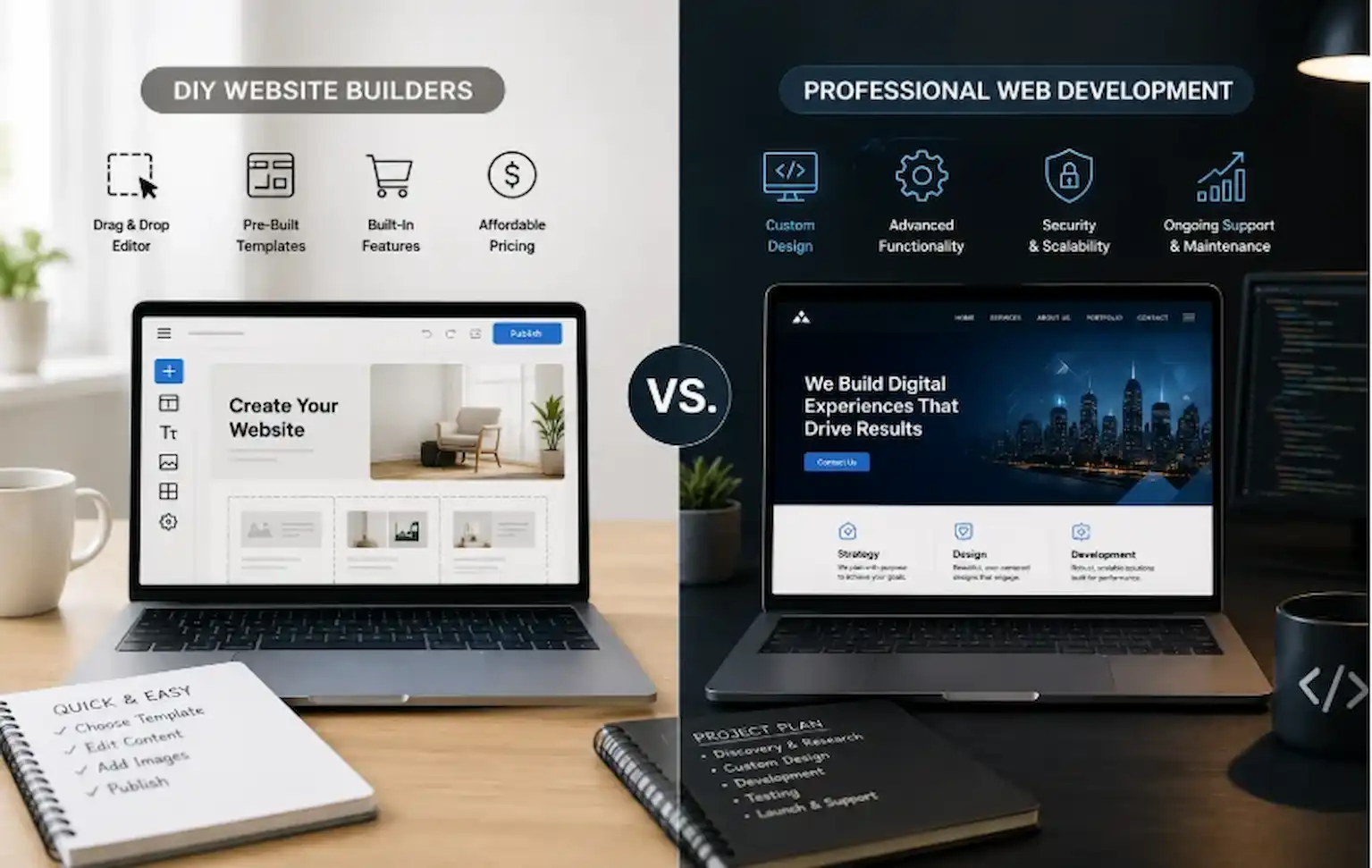
Website builders can make it possible for a business owner to launch a website with a relatively small upfront investment. For a new business testing an idea or needing a simple online presence, this may be a practical starting point.
However, DIY tools can become limiting when a company needs a more customized design, advanced functionality, stronger SEO architecture, integrations, or a website built around a specific conversion strategy.
Professional development is not necessarily about making a website more complicated. It is about having the expertise to make decisions based on the business’s goals and customers. The right option depends on the stage of the business and what the website needs to accomplish.
What About Ongoing Business Website Costs?
The initial website project is not always the only expense. Businesses may also need to budget for hosting, domain registration, website maintenance, security updates, and other ongoing costs such as:
- Domain registration
- Web hosting
- Website maintenance
- Security updates
- Plugin or software licenses
- Content updates
- Technical support
- SEO
- Performance monitoring
- New features and development
Some websites require very little maintenance, while others need regular technical attention. Businesses should therefore think about the website as an ongoing digital asset rather than a one-time purchase. A website that generates leads and supports the sales process may justify continued investment because its value extends beyond the original development cost.
How to Choose the Right Website Budget
Instead of starting with the question, “What is the cheapest business website I can build?”, start with the business objective. If you only need a basic online presence, a simpler website may be appropriate. If the website needs to generate qualified leads, support multiple services, rank for competitive search terms, and help visitors make purchasing decisions, the budget should reflect those requirements.
Start by identifying:
Your audience: Who needs to use the website?
Your goals: Do you need leads, bookings, sales, credibility, or all of these?
Your services: Which products or services need dedicated pages?
Your functionality: What tools or integrations does the business require?
Your growth plans: Will the website need to expand as the business grows?
Your marketing strategy: Will SEO, paid advertising, content marketing, or other channels send visitors to the website?
Mobile usability should also be considered from the beginning, which is why responsive website design is an important part of a modern business website. Once these requirements are clear, it becomes much easier to determine an appropriate budget.
A Practical Example of Business Website Costs
Consider a local professional service company that needs a website to generate enquiries. The company may initially assume that it only needs five pages: Home, About, Services, Contact, and Blog. After reviewing the customer journey, however, the requirements become clearer.
The business needs separate pages for its major services, a strong homepage message, testimonials, project examples, location information, a simple enquiry form, mobile optimization, analytics, and a structure that supports future SEO. The project is no longer simply a five-page website. It is a lead-generation system designed to help potential customers understand the company and take action, which is where conversion rate optimization can play an important role. That distinction is important when evaluating the business website cost. The investment should be based on the actual business requirements rather than an arbitrary page count.
How to Get an Accurate Website Quote
A reliable website quote should be based on a clearly defined scope. Before requesting proposals, prepare a basic list of your requirements. Include the number of services, preferred functionality, integrations, content requirements, target audience, and business goals.
Ask potential providers:
- What is included in the project?
- How many pages are included?
- Is the design custom or template-based?
- Who provides the content?
- Is basic SEO included?
- Is mobile optimization included?
- What functionality and integrations are covered?
- How many revision rounds are included?
- What happens after launch?
- What ongoing costs should I expect?
The answers will make it much easier to compare proposals fairly. A professional provider should be able to explain not only how much the Business website costs, but also what the investment is designed to accomplish.
If you are unsure what your business actually needs, a website consultation can help define the project’s goals, scope, and requirements before development begins
How Avenzo Digital Approaches Business Website Development

At Avenzo Digital, we believe a business website should be planned around the needs of the business and its customers, not simply around a fixed number of pages. We focus on creating websites that combine professional design, clear messaging, usability, performance, SEO-friendly structure, and conversion-focused experiences. For some businesses, that may mean improving an existing website rather than starting again. For others, a new website may provide a better foundation for growth.
Our approach begins with understanding the business, audience, services, and goals. From there, the website can be structured around the customer journey and the actions that matter to the company. The objective is not to build the most complicated website possible. It is to build the right website for the business.
Conclusion
So, how much does a business website cost in the USA? A basic website may cost a few thousand dollars, while a professionally designed lead-generation website can require a significantly larger investment. Custom functionality, advanced integrations, content, SEO, and ongoing development can increase the cost further. But the price alone should not determine the decision.
The better question is whether the website can help your business attract the right visitors, communicate its value, build trust, and turn genuine interest into enquiries or sales. A well-planned website is not simply an online brochure. It can become an important part of your marketing and sales process. When the investment is aligned with the business goals, the website has a much better opportunity to deliver value long after launch.
Frequently Asked Questions
How much does a business website cost in the USA?
A basic business website may cost around $1,500 to $5,000, while a more comprehensive lead-generation website may range from $5,000 to $15,000 or more. Custom websites with advanced functionality can exceed $15,000. Actual costs depend on scope, design, functionality, content, and development requirements.
What is the average cost of a small business website?
Many small businesses can expect to invest several thousand dollars in a professionally developed website. The final cost depends on the number of pages, design requirements, functionality, content, SEO, and whether the website is built from a template or customized.
Is it cheaper to build a business website yourself?
DIY website builders can reduce upfront costs, particularly for businesses that only need a basic online presence. However, professional development may provide greater value when a business needs custom design, advanced functionality, SEO, integrations, or a website specifically designed to generate leads.
What makes a business website more expensive?
Custom design, additional pages, professional content, advanced functionality, integrations, e-commerce, custom development, SEO requirements, and ongoing support can all increase the total cost.
Does SEO affect website development costs?
Yes. SEO-friendly architecture, content, page structure, internal linking, technical optimization, and other search considerations can require additional planning and development. Building these elements into the website from the beginning can be more efficient than correcting structural issues later.
Should I pay for a custom website or use a template?
It depends on your goals. A template can work well for a simple website with a limited budget. A custom website may be more appropriate when the business needs a distinctive brand experience, specific functionality, advanced integrations, or a website built around a particular customer journey.
Are there ongoing costs after a website is launched?
Yes. Businesses may need to budget for hosting, domain registration, maintenance, security updates, software licenses, content updates, technical support, and SEO or performance improvements.
How do I know how much I should spend on my business website?
Start with the website’s purpose and business requirements. Consider your audience, goals, services, functionality, marketing strategy, and future growth. Once those requirements are clear, you can choose a budget based on what the website needs to accomplish rather than simply choosing the cheapest option.